


Designing and Funding Griffin's Downtown Catalyst Flex Grant
I wrote and secured funding for Griffin's Downtown Catalyst Flex Grant, a $200,000 performance-based gap-financing program built to unlock major downtown redevelopment projects while protecting public funds.
This project documents the creation of Griffin’s Downtown Catalyst Flex Grant Program. I wrote the policy, built the supporting forms and review tools, and secured a $200,000 public allocation for initial implementation through the City of Griffin Downtown Development Authority.
The goal was simple: create a grant tool strong enough to help close real redevelopment gaps, but disciplined enough to protect public money.
Targeted public money works best when it is structured to pull in far more private investment than it puts at risk.
Project Overview
| Project Parameter | Details |
|---|---|
| Program Author | Jason Chance |
| Administering Body | City of Griffin Downtown Development Authority |
| Initial Allocation Approved | $200,000 |
| Minimum Private Capital Threshold | $500,000 |
| Funding Cap Structure | Maximum 10% of verified total capital investment |
| Construction Window | Must start within 12 months and end within 24 months, with extensions available |
| Reimbursement Structure | 100% reimbursement after completion, CO issuance, and receipt audit |
| Clawback Protection | 4-year declining repayment schedule |
| Peak Catalyst Ratio | 22.5:1 |
The Problem
Large downtown redevelopment projects often fail at the point where enthusiasm runs into financing reality. In historic districts, developers regularly face structural surprises, code-driven rehabilitation costs, facade preservation work, and lender limits that leave a late-stage funding gap.
That gap is especially dangerous in smaller markets. A project can be viable in every other respect and still stall because one part of the capital stack does not close.
Downtown Griffin needed a tool designed for that problem. It did not need a broad subsidy program or a loose grant fund. It needed a targeted gap-financing mechanism tied to real investment, real execution, and real accountability.
The Policy Design
I built the Downtown Catalyst Flex Grant as a performance-based capital tool, not an open-ended incentive.
The program’s main rules were designed to keep the public side disciplined:
- $500,000 minimum capital investment. Projects under that threshold are automatically disqualified from review.
- 10% maximum grant cap. No award can exceed 10% of verified project funding.
- Hard-cost focus. The program is aimed at construction, stabilization, and core project delivery rather than soft overhead.
- Structured project timeline. Construction must begin within 12 months and end within 24 months, with a limited extension path available when continued board review is warranted.
- Single reimbursement payout. No money goes out upfront. Payment occurs after completion, local sign-offs, Certificate of Occupancy issuance, and a line-item receipt audit.
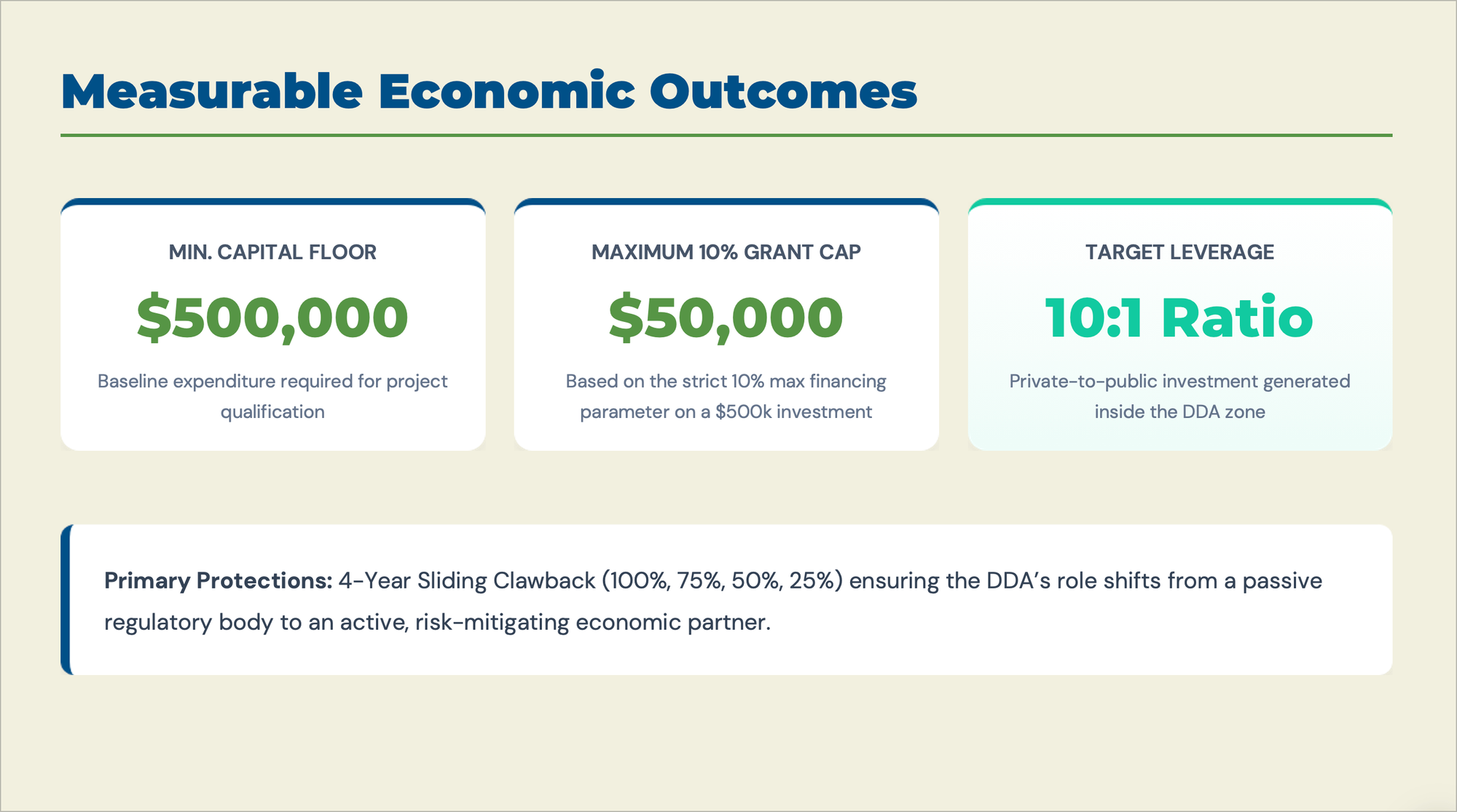
Capstone presentation slide summarizing the program’s capital floor, grant cap, and target leverage structure.
Those guardrails came directly from the core problem the program was built to solve. The grant had to be meaningful enough to matter, but strict enough to avoid becoming a casual giveaway.
Main Street and Redevelopment Alignment
I also wrote the program so it lined up with the kinds of outcomes a downtown board should actually care about.
That does not mean every funded project has to check every box in the economic development section. The threshold is more practical than that.
- First, the deal has to meet the baseline leverage test: at least a 10:1 total investment ratio
- Second, it has to advance at least one other public outcome strongly enough to justify the award: such as tax base growth, job creation, long-term vacancy removal, upper-story housing, or another meaningful downtown redevelopment benefit
1. Economic Vitality
The scoring and eligibility structure favors projects that expand the tax base, create full-time equivalent jobs, remove long-term vacancy, and add mixed-use activity to the district. Those are qualifying impact paths, not a mandatory all-of-the-above checklist.
The application materials specifically track projected FTE job creation within 24 months. The intake structure also addresses vacancy duration and the quality of the proposed private investment.
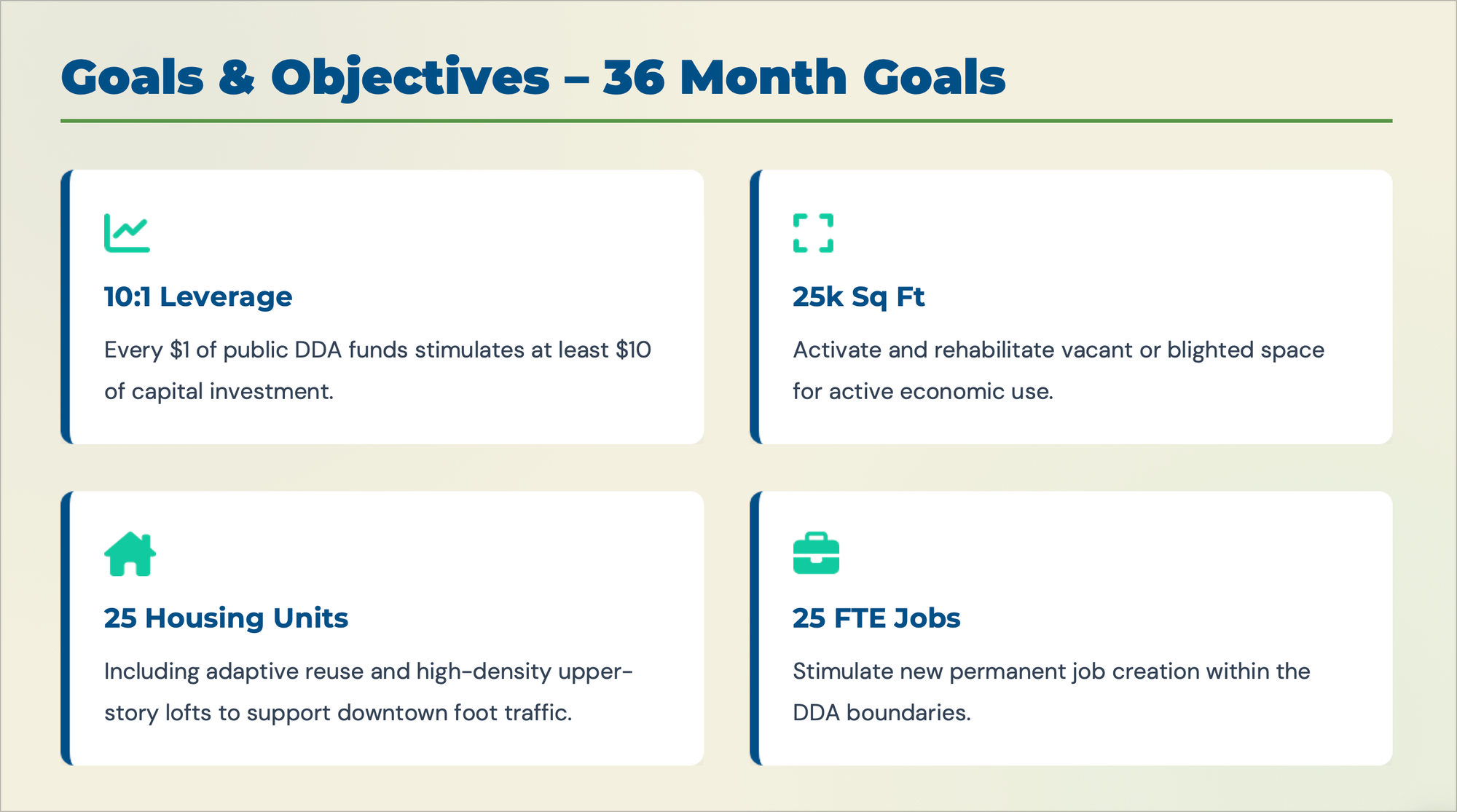
Capstone presentation slide showing the 36-month performance targets used to frame the program’s public outcomes.
2. Design Integrity
The program requires compliance with Griffin’s downtown zoning and overlay conditions. Where a project falls within the downtown historic district, it also has to secure Historic Preservation Commission approval if that review is applicable. Applicants have to present architectural drawings, site plans, or renderings to the board. Eligible costs are constrained so public money supports real physical project work rather than loose soft costs.
3. Organizational Accountability
The reimbursement model is one of the most important parts of the policy. The DDA does not advance money at project start. The grantee has to complete the work, document the expenses, secure the final Certificate of Occupancy, and pass a receipt audit before public funds are released.
The timeline rules are part of that accountability structure. The deadline and extension framework gives the board a formal reason to review project status at regular intervals, require updated documentation, and decide whether the agreement should continue. In practice, the extension process creates a 90-day reporting checkpoint that helps the board stay informed and, if necessary, terminate the agreement and unencumber the funds before a weak project drifts indefinitely.
The program also includes a four-year clawback schedule:
- Year 1 default: 100% repayment
- Year 2 default: 75% repayment
- Year 3 default: 50% repayment
- Year 4 default: 25% repayment
That structure gives the board a real enforcement mechanism if a project closes early or fails to meet the program’s operating expectations.
Financial Impact
The most important number in this program is not the grant amount. It is the leverage.
At its baseline structure, the program is designed so public funding does not exceed 10% of the total capital stack. In practical terms, that means a qualifying project should deliver at least $10 in total investment for every $1 in grant support.
At the minimum threshold, a $50,000 grant on a $500,000 redevelopment project still produces a 10:1 investment ratio and keeps the public share capped at 10%.
Even at the minimum qualifying level, a targeted public grant can help unlock a much larger private redevelopment investment.
Public grant dollars should act as a catalyst for private investment, not a handout.
The goal is to use limited public funds to move strong redevelopment projects across the finish line and generate a return for the district that far exceeds the original award.
The point of the program is not to fund projects alone. The point is to move major projects that are already close, but still missing one critical piece.
What I Produced
This project was not just a concept memo. I created the full working grant package, including:
- program overview materials,
- application and checklist documents,
- board evaluation tools,
- pre-application intake materials,
- annual reporting forms,
- extension request paperwork,
- and the DDA / TAD1 overlay reference materials used for eligibility review.
Download the Grant Files
These files are available for other cities, downtown boards, and development authorities to review and adapt:
These materials were created for the City of Griffin and were reviewed in that local context, including review by legal counsel for the Griffin Downtown Development Authority. They are shared as examples only, not as legal advice or a one-size-fits-all template for other jurisdictions. Any city, downtown board, or development authority using this program as a reference should have its own legal counsel review and revise all documents before adoption or use.
- Download the full grant package ZIP
- Grant Program Overview
- Application and Checklist
- Board Evaluation Sheet
- Pre-Application Intake Checklist
- Annual Project Update Report
- Project Milestone Extension Request
The Griffin Downtown Development Authority is funded through a Tax Allocation District in our downtown area. Because this grant uses TAD-backed DDA funding, applicants must be located within the TAD1 district, which is why the grant package includes the TAD1 map. Other downtown authorities may be funded differently and may not need that same district-specific eligibility layer. For more on why TAD can be such a powerful DDA funding tool, see my post on why a Tax Allocation District is the ultimate funding engine for downtown revitalization.
Certified Downtown Professional Capstone
This grant was also created as my capstone project for the Certified Downtown Professional program. That certification is designed to develop practical downtown leadership skills across economic vitality, design, organization, and implementation.
Using the Downtown Catalyst Flex Grant as the capstone project mattered because it was not a theoretical exercise. It was a real policy tool built for a real downtown redevelopment problem, then structured for board adoption and public use.
If another city wants a starting point for thinking through its own gap-financing tool, the presentation is worth reviewing alongside the working grant documents.
Why This Work Matters
Smaller cities rarely lack ideas. They usually lack tools that are precise enough to move hard projects.
This grant gave Griffin a way to respond to real redevelopment barriers with a structure that is measurable, enforceable, and built around private capital discipline. It also created a reusable template other cities can study instead of starting from a blank page.