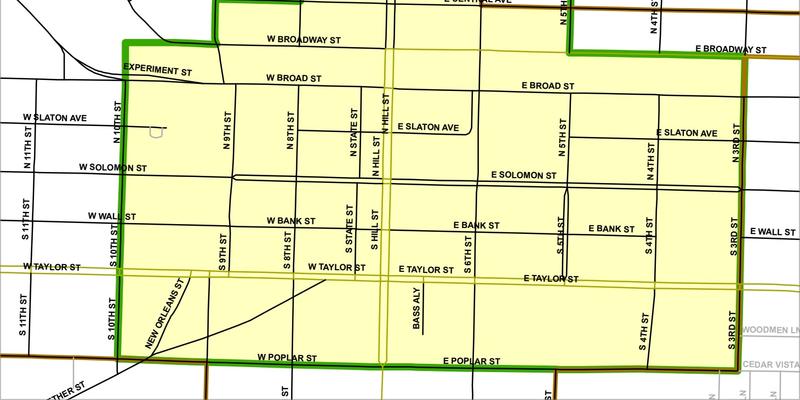
Downtown Development Authorities (DDAs) across Georgia face a recurring challenge: ambitious master plans paired with limited funding. Traditional tax revenue stays locked in general funds, while standard grants come with rigid spending rules.
A Tax Allocation District (TAD) solves this problem. In my view, a dedicated TAD is the best mechanism to fund a DDA because it directly captures the value a board creates and reinvests it into the immediate district. It also pairs directly with the kinds of physical improvements discussed in my posts on walkability as economic infrastructure and adaptive reuse deal structuring in Georgia.
The Financial Mechanics of a Georgia TAD
Under the Georgia Redevelopment Powers Law [1], municipalities can establish Tax Allocation Districts to catalyze commercial development in target areas. The underlying math relies on a simple increment structure:
- The Property Tax Baseline: When a city creates a TAD, the state certifies the baseline property values within the district boundaries. Local taxing bodies continue to receive revenues based on this frozen amount.
- The Revenue Increment: Private improvements and property value growth generate new ad valorem tax revenue above the baseline.
- Targeted Reinvestment: That tax increment bypasses the general fund and routes directly into a restricted TAD account. [2]
| Revenue Stream | Where It Goes |
|---|---|
| Base value tax (frozen at TAD creation) | General operating funds: city, county, schools |
| Incremental value tax (growth above baseline) | TAD Fund: infrastructure and DDA reinvestment |
By linking revenue directly to localized commercial growth, the TAD establishes a self-funding loop: successful public investment raises real estate values, which increases the tax increment for the next project.
Why TADs Outperform Traditional DDA Funding
Other funding models limit what a DDA can execute. Municipal appropriations shift with changing political cycles, while general obligations require debt service paid out of general revenues.
A TAD offers distinct structural advantages for downtown development:
- Alignment of Incentives: The DDA earns revenue by making the downtown core more valuable. When property values rise, authority resources expand.
- True Intergovernmental Partnerships: Under Georgia law, cities, counties, and school districts can all opt into a TAD [1]. Uniting these taxing entities magnifies the increment without increasing millage rates for property owners.
- Risk Mitigation for Private Capital: Developers often back away from historic centers due to aging utilities, poor pedestrian access, or structural deficiencies. TAD funds offset these initial site preparation costs. [2]
Maximizing Impact: Griffin’s TAD1
In Griffin, Tax Allocation District 1 (TAD1) serves as the primary financial driver for downtown economic strategy. [3] Governed by the local redevelopment plan, TAD1 yields dedicated funding that the Griffin DDA can deploy toward targeted interventions:
- Directing matching funds toward historic facade restorations.
- Upgrading utility connections and pedestrian corridors to attract private investment.
- Soliciting private developers for underutilized, blighted properties.
Without a structured increment, individual property improvements yield small tax gains spread across broad general funds. TAD1 concentrates those returns right where they are earned, giving the DDA the capital needed to transform the commercial core. When the public side needs to move beyond financing and into actual deal mechanics, the next step is a clear partnership structure between the public sector and private developers.
Frequently Asked Questions
A TAD freezes the base property tax value in a defined district and captures the incremental tax revenue generated by rising property values for reinvestment inside that district.
It directly ties DDA funding to the value created by downtown improvements, creating a self-reinforcing funding stream for future projects.
Yes. Cities, counties, and school districts can opt into a TAD, which can increase the available increment without raising millage rates.
References
- General Assembly of Georgia. (1985). Georgia Redevelopment Powers Law. Official Code of Georgia Annotated (O.C.G.A.) \S 36-44-1 et seq.. https://law.justia.com/codes/georgia/2022/title-36/chapter-44/
- Georgia Department of Community Affairs. (2021). Tax Allocation District (TAD) Basics and Best Practices. State of Georgia. https://dca.georgia.gov/search/results
- City of Griffin, Georgia. (2024). Code of Ordinances: Chapter 2, Article III — Tax Allocation District #1 (Fund 271). City Records. https://library.municode.com/ga/griffin