Local government boards and development authorities routinely evaluate complex proposals for physical infrastructure. Board members know how to review engineering bids, inspect site plans, and evaluate construction contracts.
Software infrastructure is different. When a board needs an application to manage grants, track commercial site inventory, or run local economic programs, evaluating technical proposals becomes difficult. [1] Tech jargon, vague vendor promises, and shifting scopes often lead to budget overruns or unusable systems.
Evaluating software proposals requires the same rigor as physical construction. Here is a method for vetting software vendors, choosing between custom development and commercial platforms, and protecting public dollars. It also connects directly to the broader discoverability and content-structure issues I covered in What your web developer won’t tell you: AI Aggregation and Zero-Click Searches.
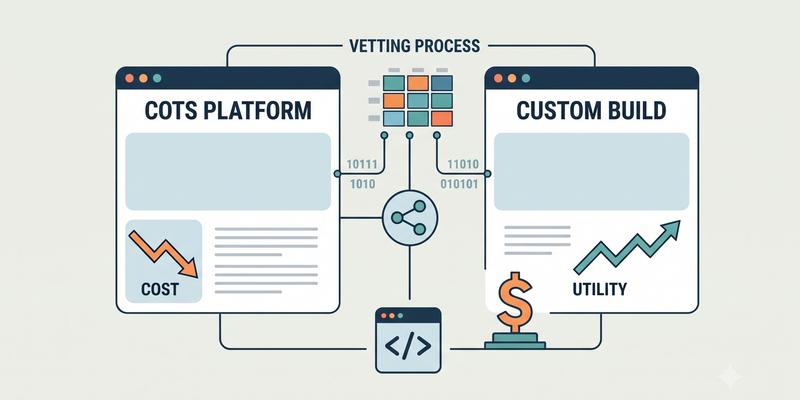
Commercial Off-the-Shelf vs. Custom Development
Before issuing a solicitation or reviewing bids, determine whether custom software is necessary.
- Commercial Off-the-Shelf (COTS): Pre-built software platforms with existing user bases.
- Pros: Lower upfront costs, fast deployment, vendor-managed maintenance, routine security updates.
- Cons: Recurring subscription fees, limited customization, rigid workflows, vendor lock-in.
- Custom Development: Software built specifically to match unique workflows or local mandates.
- Pros: Tailored to exact statutory requirements, full ownership of the platform, no per-user license fees.
- Cons: Higher upfront costs, longer delivery timeline, ongoing maintenance responsibilities.
The Rule of Thumb: If a process is standardized across municipalities (e.g., meeting agendas or basic accounting), buy existing software. If a process is dictated by unique local ordinances, specialized grant structures, or local economic workflows, custom development is often the better long-term investment. [2]
| Buy COTS When… | Build Custom When… |
|---|---|
| Workflows are standardized across municipalities | Processes are governed by unique local ordinances |
| Upfront budget is limited | Long-term capital is available |
| Immediate deployment is required | Specific workflow automation is non-negotiable |
Vetting Vendor Capabilities Beyond the Pitch
Software sales presentations showcase polished prototypes and feature lists. Boards must look past the presentation and evaluate operational capabilities:
- Source Code Ownership: Require full ownership of custom code and intellectual property. If a vendor goes out of business, the board must retain access to the source code and databases.
- Technical Stack Longevity: Ensure software relies on modern, mainstream open-source languages and libraries. Avoid proprietary, obscure stacks that make hiring future developers impossible.
- Security and Public Records Compliance: Require explicit protocols for data encryption (in transit and at rest), user access controls, and compliance with open records retention laws. [3]
Structuring Public Software Contracts
Time-and-materials contracts for software often lead to expanding scopes and ballooning budgets. Boards should structure technology contracts using fixed-phase milestones. The same logic carries into real-estate redevelopment agreements too, especially when the public side needs clearly defined risk allocation and milestone-based obligations:
- Discovery and Architecture Phase: Pay a fixed fee for a detailed system specification, user interface wireframes, and database architecture before committing to full buildout costs.
- Milestone-Based Payments: Tie payments directly to testable, working software components.
- Service Level Agreements (SLAs): Define response times for critical bugs, uptime guarantees, and fixed hourly rates for post-launch enhancements.
Frequently Asked Questions
Buy commercial off-the-shelf software when the workflow is standardized across municipalities. Build custom when local ordinances, grant structures, or specialized workflows require a tailored system.
At minimum, require source code ownership, a durable mainstream technical stack, and explicit security and public records compliance requirements.
The post recommends fixed-phase contracts with a discovery and architecture phase, milestone-based payments tied to working software, and service level agreements for support and uptime.
References
- Georgia Department of Community Affairs. (2022). Technology Implementation and Vendor Management for Municipalities. State of Georgia. https://dca.georgia.gov
- Georgia Municipal Association. (2023). Digital Infrastructure Procurement Guidelines for Local Officials. Georgia Municipal Association. https://www.gmanet.com/
- General Assembly of Georgia. (1982). Georgia Open Records Act. Official Code of Georgia Annotated (O.C.G.A.) \S 50-18-70 et seq.. https://law.justia.com/codes/georgia/2022/title-50/chapter-18/article-4/section-50-18-70/