Search behavior has changed permanently. Out of every 1,000 Google searches in the United States, only 360 clicks reach external websites. The remaining 640 searches end without a click, direct traffic to Google properties, or trigger another search. [1]
Device type creates a large gap in search behavior. On mobile devices, 77 percent of Google searches end without a single click to an external website. Desktop searches show a 46.5 percent zero-click rate. When Google displays an AI Overview, the zero-click rate across all devices jumps to 83 percent. In Google AI Mode, that number reaches 93 percent. [2]
These statistics signal a structural shift in web design and internet architecture. For thirty years, the web relied on a simple exchange. Web developers created content, search engines indexed it, and users clicked links to visit websites. That exchange is over. Search engines now act as destination engines. They extract your data, summarize your facts, and answer user queries directly on the search results page.
This shift changes the future of web design. Web pages can no longer rely on visual layouts alone to capture user attention after arrival. Developers must build sites for two distinct consumers: human visitors who arrive for deep interactions, and AI crawlers that parse content instantly for summary engines. That same logic applies to civic content too, including my post on software vendor vetting for local government boards and related writing on public-side deal structuring, where findability matters as much as the substance.
If your site fails to communicate clearly to AI scrapers, your message becomes invisible.
Here are 5 specific methods web developers must use to ensure their message gets parsed, cited, and delivered in an AI-aggregated web:
1. Implement Deep JSON-LD Schema Markup
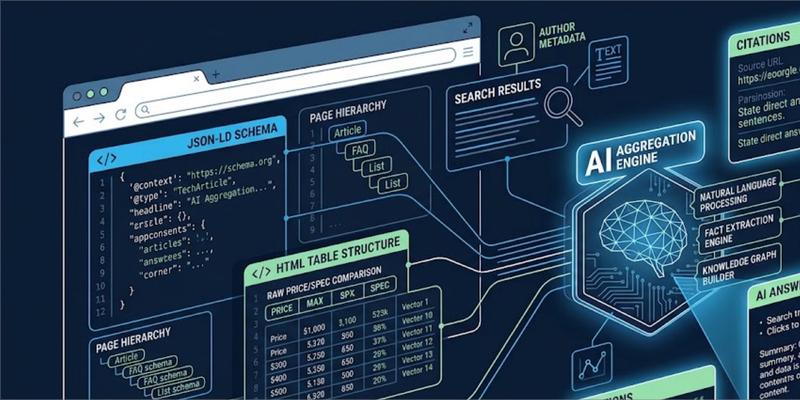
AI bots do not guess your content structure. They parse structured data. You must add exact JSON-LD schema across your site. [3], [4]
- Add
TechArticleorArticleschema to every post. Include publication dates, author metadata, and publisher information. - Use
FAQPageschema for question-and-answer sections. Plain text paragraphs force the AI to extract facts blindly. Schema hands the facts directly to the crawler. - Add
ItemListmarkup for roundups and lists. This ensures the parser attributes each list item directly to your domain.
2. Place Direct Answers in the Top 100 Words
AI models prioritize early page text. Long introductions waste crawl budget and reduce your chances of citation.
- State the main fact or solution in the first two sentences.
- Use a clear question as your H2 tag, then answer it directly in the immediate paragraph.
- Keep answer sentences under 20 words. Concise statements parse cleanly into AI summaries.
3. Use HTML Tables and Unordered Lists for Raw Data
AI summaries extract tabular data reliably. Standard text blocks frequently get misquoted or ignored.
- Put pricing, specifications, and comparison data into HTML tables with clear
thheaders. - Use
ulandollists for step-by-step technical instructions. - Avoid custom JavaScript table renders that block static crawlers.
4. Increase Web Server Speed for AI Bots
AI scrapers visit millions of pages per minute. If your server response time exceeds 300 milliseconds, crawlers skip your deeper content.
- Serve static HTML through a CDN. Minimize dynamic server rendering on content pages.
- Remove blocking JavaScript scripts that delay DOM completion.
- Check your
robots.txtfile to ensure you do not block modern search engine AI user agents.
5. Add Verifiable Source Attribution
AI models prefer content backed by data. Unverified claims get discarded during summary generation.
- Include exact statistics and cite primary sources directly in your text.
- Link out to reputable primary sources. AI engines verify external links to score page trustworthiness.
- Update your content timestamps whenever you update data points.
The zero-click search metrics, device behavior splits, and technical schema standards referenced in this post are grounded in the following industry studies and documentation:
References
- Fishkin, Rand. (2024). 2024 Zero-Click Search Study: For Every 1,000 Searches, 360 Clicks Leave Google. SparkToro. https://sparktoro.com/blog/2024-zero-click-search-study/
- Bain, Mark. (2025). Measuring the Impact of AI Overviews and Google AI Mode on organic CTR. SEO Clarity. https://www.seoclarity.net/
- Schema.org Community Group. (2026). Schema.org Vocabulary: TechArticle, Article, and FAQPage Guidelines. W3C Schema.org Community Group. https://schema.org/TechArticle
- Google Search Central. (2025). Google-Extended and Googlebot Documentation: Structuring Data for AI Features. Google LLC. https://developers.google.com/search/docs/appearance/structured-data/intro-structured-data