Major downtown catalyst projects often require property tax relief to achieve financial viability. However, the Georgia Constitution restricts municipal grants and direct tax exemptions. Article VII, Section I, Paragraph III mandates uniform property taxation across all subjects [1]. Local governments cannot grant direct property tax forgiveness to private companies.
Downtown Development Authorities (DDAs) solve this restriction through leasehold structures under O.C.G.A. § 36-42-1 et seq. (Downtown Development Authorities Law) [2]. Public entities do not pay ad valorem property taxes on real estate they own. When a DDA holds legal title to a property, the real estate becomes tax-exempt. The developer holds a leasehold interest, paying property taxes only on the taxable value of that leasehold interest.
Leasehold ownership structures grant legal property tax relief without violating constitutional rules.
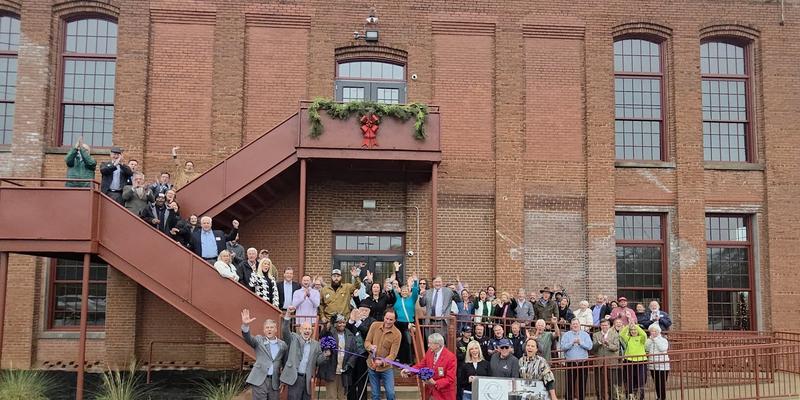
That structure is not theoretical. In Downtown Griffin, the completed redevelopment of the historic Thomaston Mill into The Carlisle shows the kind of catalytic project these tools are designed to support. The ribbon cutting marked the delivery of 225 loft apartments in a reused mill building, and the project was publicly framed by Downtown Griffin as a partnership between the Downtown Development Authority and the developer that combined historic preservation, adaptive reuse, and downtown housing production.
1. The “Phantom Bond” Mechanism
To execute a Bond-for-Title deal, the developer and the DDA enter a sale-leaseback transaction. The DDA issues revenue bonds to fund project acquisition and construction.
In most economic development deals, these obligations function as non-recourse revenue bonds, often called “phantom bonds” [3].
How the Transaction Works
- Title Transfer: The developer transfers legal fee simple title of the property to the DDA.
- Bond Issuance: The DDA issues revenue bonds. The developer or an affiliated financial partner purchases the entire bond issue.
- Lease Agreement: The DDA leases the property back to the developer for a fixed term, usually 10 years.
- Debt Offset: The developer pays lease rent to the DDA, and the DDA uses those rent payments to pay principal and interest on the bond. Because the developer holds both the lease obligation and the bond, money flows in a closed loop. No public debt or taxpayer funds are pledged.
2. Leasehold Valuation and Ramp-Up Schedules
The developer does not receive a 100% tax exemption. County tax assessors evaluate the economic value of the developer’s leasehold interest over the lease term [4].
As the lease progresses, the value of the leasehold interest increases toward full market value. Economic development authorities structure standardized ramp-up schedules to provide predictability for investors and local taxing jurisdictions [5].
Sample 10-Year Leasehold Tax Payment Schedule
| Lease Year | Taxable Value Share | Abatement Percentage | Tax Paid Share |
|---|---|---|---|
| Year 1 | 50% | 50% | 50% |
| Year 2 | 55% | 45% | 55% |
| Year 3 | 60% | 40% | 60% |
| Year 4 | 65% | 35% | 65% |
| Year 5 | 70% | 30% | 70% |
| Year 6 | 75% | 25% | 75% |
| Year 7 | 80% | 20% | 80% |
| Year 8 | 85% | 15% | 85% |
| Year 9 | 90% | 10% | 90% |
| Year 10 | 95% | 5% | 95% |
| Year 11+ | 100% | 0% | 100% |
Gradual tax ramp-up schedules balance developer viability with long-term public revenue.
3. PILOT Agreements and Intergovernmental Coordination
Tax abatements affect three distinct local taxing jurisdictions: the municipality, the county, and the local school district. A DDA must build consensus across all three bodies before approving a deal.
To protect local budgets, the DDA and the developer execute a Payment in Lieu of Taxes (PILOT) agreement [6].
Core PILOT Contract Components
- Base Value Protection: The developer agrees to pay property taxes equal to or greater than the pre-development base property tax yield. Local taxing bodies never lose existing revenue.
- Clawback Remedies: If the developer fails to hit agreed job targets, housing unit counts, or capital investment numbers, the DDA reduces or cancels the tax abatement schedule.
- School Board Allocations: PILOT agreements often guarantee full or partial tax payments directly to local school boards to prevent funding reductions for public education.
- Reconveyance Terms: When the bond term ends, the developer purchases the fee simple title back from the DDA for a nominal fee, commonly between $100 and $1,000, returning the property to full tax assessment.
4. What This Looks Like on the Ground in Griffin
Large mill redevelopments are exactly where bond-for-title and PILOT structures matter most. Historic buildings usually carry higher rehabilitation costs, longer predevelopment timelines, and more financing complexity than greenfield projects. If local leaders want to save a landmark building and still make the numbers work, they often need a lawful way to reduce carrying costs during the early years of operation.
That is why projects like The Carlisle are such useful real-world examples. In Griffin, the former Thomaston Mill was a large historic industrial property whose reuse could add housing, preserve a recognizable local asset, and bring more residents within walking distance of Downtown businesses. For that kind of project, even a temporary reduction in effective property tax burden can materially improve feasibility during lease-up and stabilization.
The broader point is simple: tax-abatement tools are not ends in themselves. They are part of a larger redevelopment strategy. When a DDA uses them well, the goal is to unlock a project that produces public value a community would be unlikely to get otherwise: occupied historic buildings, new residents downtown, stronger adjacent property values, and a larger long-term tax base once the abatement period ends.
Bond-for-title structures are most powerful when they are paired with disciplined redevelopment underwriting. In practice, they complement the same toolkit I described in my posts on Tax Allocation Districts, land banks and infill development, and public-private partnerships in Georgia downtown projects.
Frequently Asked Questions
Because Georgia’s constitution requires uniform taxation within the same class of property, local governments generally cannot grant direct, discretionary property tax forgiveness to a private company.
It is a sale-leaseback structure in which a public development authority holds legal title, issues revenue bonds, and leases the property back to the private user so the project can receive lawful leasehold-based property tax relief.
A Payment in Lieu of Taxes agreement sets the developer’s negotiated tax-like payments, protects base revenues, and establishes clawbacks or other conditions tied to project performance.
References
- State of Georgia. (2024). Constitution of the State of Georgia: Article VII, Section I, Paragraph III (Uniformity of Taxation). https://law.justia.com/constitution/georgia/conart7.html
- General Assembly of Georgia. (2024). Downtown Development Authorities Law (O.C.G.A. \S 36-42-1 et seq.). https://law.justia.com/codes/georgia/title-36/provisions-applicable-to-municipal-corporations-only/chapter-42/section-36-42-1/
- McRae, Dan. (2014). Bonds For Title. Dan McRae & Associates. https://www.danmcrae.com/whitepapers/2014-01-Bonds-For-Title-White-Paper.PDF
- Georgia Department of Revenue. (2024). Local Government Services. Georgia Department of Revenue, Local Government Services Division. https://dor.georgia.gov/local-government-services
- McRae, Dan. (2016). Bonds for Title Made Simple. Dan McRae & Associates. https://www.danmcrae.com/whitepapers/2016-04-11-Bonds-for-Title-Made-Simple.pdf
- Georgia Municipal Association. (2024). Handbooks, Manuals, and Publications. Georgia Municipal Association. https://www.gacities.com/resources/gma-handbooks-manuals-publications.aspx