Designing and Funding Griffin's Downtown Catalyst Flex Grant
I wrote and secured funding for Griffin's Downtown Catalyst Flex Grant, a $200,000 performance-based gap-financing program that helps big downtown redevelopment projects close while protecting public money.
This is how I created Griffin’s Downtown Catalyst Flex Grant Program. I wrote the policy, built the forms and review tools, and secured a $200,000 public allocation for the first round through the City of Griffin Downtown Development Authority.
The goal was simple. I wanted a grant tool strong enough to help close real redevelopment gaps, and disciplined enough to protect public money.
Targeted public money works best when it’s set up to pull in far more private investment than it puts at risk.
Project Overview
| Project Parameter | Details |
|---|---|
| Program Author | Jason Chance |
| Administering Body | City of Griffin Downtown Development Authority |
| Initial Allocation Approved | $200,000 |
| Minimum Private Capital Threshold | $500,000 |
| Funding Cap Structure | Maximum 10% of verified total capital investment |
| Construction Window | Must start within 12 months and end within 24 months, with extensions available |
| Reimbursement Structure | 100% reimbursement after completion, CO issuance, and receipt audit |
| Clawback Protection | 4-year declining repayment schedule |
| Public/Private Investment Ratio | 10:1 |
The Problem
A lot of big downtown redevelopment projects fall apart right where enthusiasm runs into the financing. In historic districts, developers keep running into structural surprises, code-driven rehab costs, facade preservation work, and lender limits that leave a funding gap late in the game.
That gap is especially dangerous in smaller markets. A project can work in every other way and still stall because one piece of the capital stack won’t close.
Downtown Griffin needed a tool built for that problem. A broad subsidy program or a loose grant fund wouldn’t do it. We needed targeted gap financing tied to real investment, real construction, and real accountability.
The Policy Design
I built the Downtown Catalyst Flex Grant as a performance-based capital tool with firm limits. It isn’t an open-ended incentive.
I wrote the main rules to keep the public side disciplined:
- $500,000 minimum capital investment. Projects under that threshold are automatically disqualified from review.
- 10% maximum grant cap. No award can exceed 10% of verified project funding.
- Hard-cost focus. The program goes toward construction, stabilization, and core project delivery, not soft overhead.
- Structured project timeline. Construction has to begin within 12 months and end within 24 months. There’s a limited extension path when the board decides continued review is warranted.
- Single reimbursement payout. No money goes out upfront. Payment comes after completion, local sign-offs, Certificate of Occupancy issuance, and a line-item receipt audit.
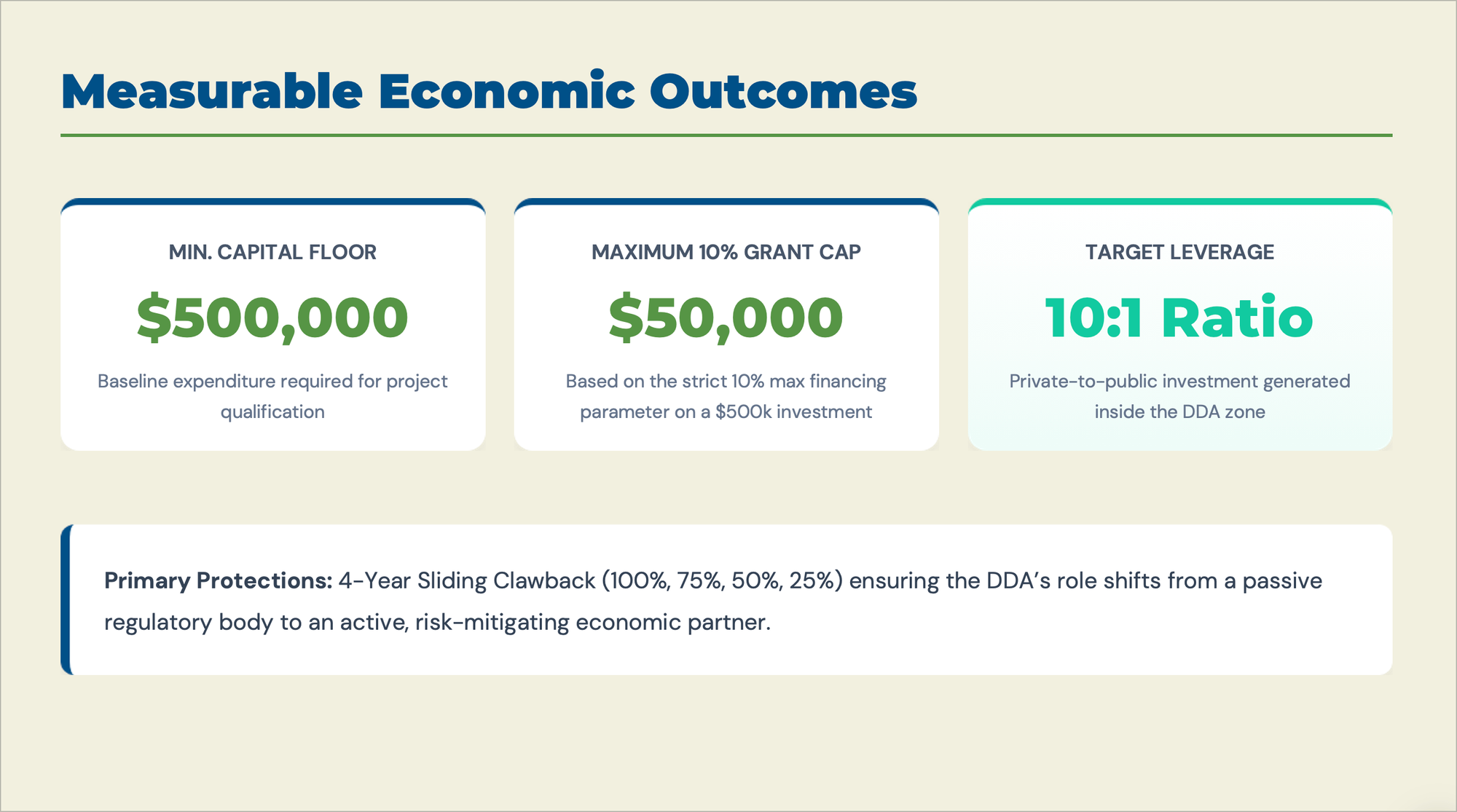
A slide from my capstone presentation with the program’s capital floor, grant cap, and target investment ratio.
Those guardrails came straight from the problem the program was built to solve. The grant had to be big enough to make a difference on a project, and strict enough that it never turned into a casual giveaway.
Main Street and Redevelopment Alignment
I also wrote the program to line up with the outcomes a downtown board should actually care about.
That does not mean every funded project has to check every box in the economic development section. The bar is more realistic than that.
- First, the deal has to pass the baseline investment test: at least a 10:1 total investment ratio
- Second, it has to push at least one other public outcome far enough to justify the award: like tax base growth, job creation, getting rid of long-term vacancy, upper-story housing, or another real downtown redevelopment benefit
1. Economic Vitality
The scoring and eligibility rules favor projects that grow the tax base, create full-time equivalent jobs, fill long-term vacancies, and add mixed-use activity to the district. Any one of those can qualify a project. It’s not an all-of-the-above checklist.
The application asks for projected FTE job creation within 24 months. The intake process also covers how long a building has been vacant and the quality of the proposed private investment.
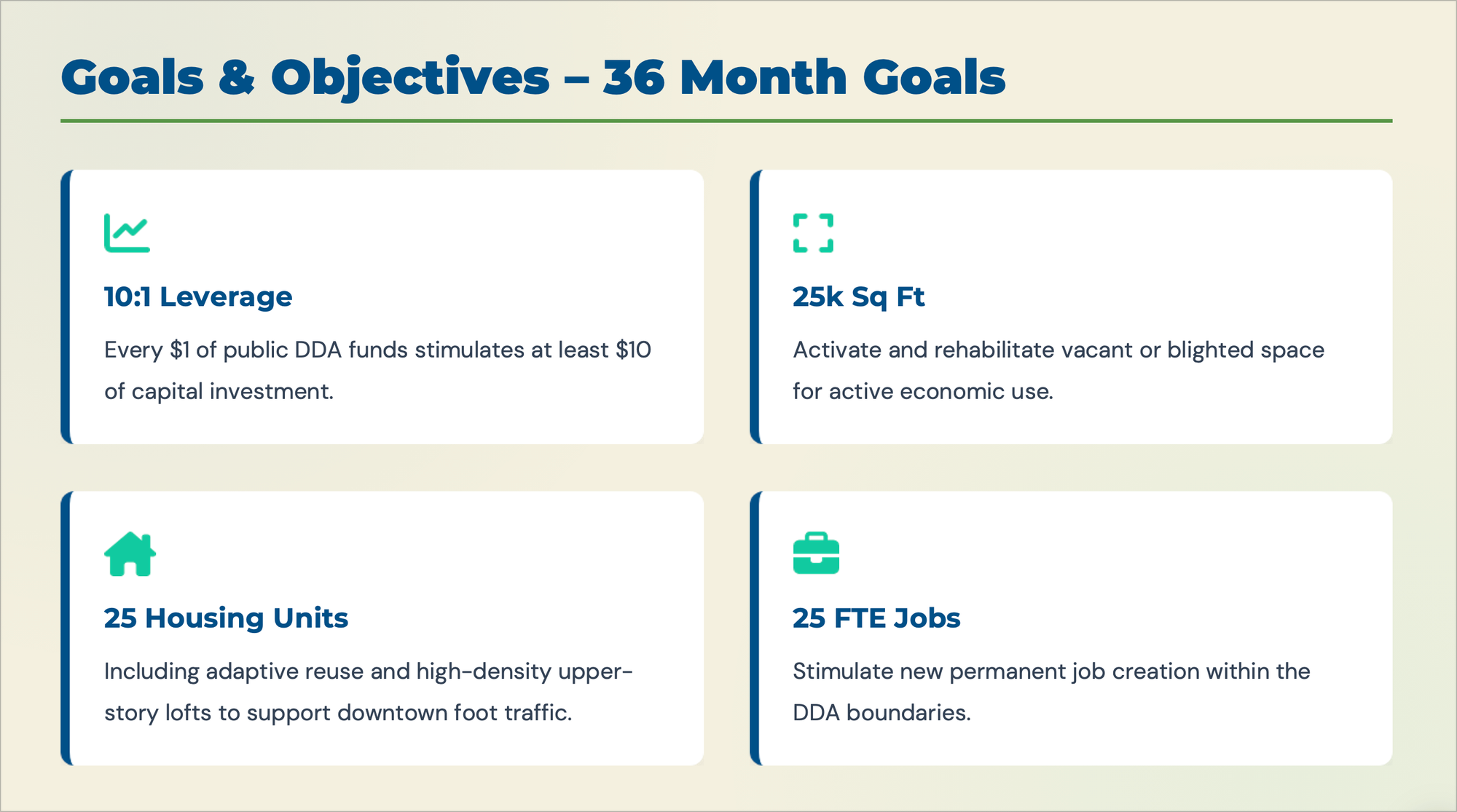
A slide from my capstone presentation with the 36-month performance targets I used to frame the program’s public outcomes.
2. Design Integrity
Projects have to comply with Griffin’s downtown zoning and overlay conditions. If a project is in the downtown historic district, it also has to get Historic Preservation Commission approval when that review applies. Applicants have to show the board architectural drawings, site plans, or renderings. Eligible costs are limited so public money goes to real physical work on the project and not loose soft costs.
3. Organizational Accountability
I’d say the reimbursement model is one of the most important parts of the policy. The DDA doesn’t advance any money when a project starts. The grantee has to finish the work, document the expenses, get the final Certificate of Occupancy, and pass a receipt audit before any public funds go out.
The timeline rules are part of that accountability too. The deadlines and the extension process give the board a formal reason to check on a project at regular intervals, ask for updated documentation, and decide whether the agreement should continue. The extension process works out to a 90-day reporting checkpoint. That keeps the board informed and, if it comes to it, lets the board end the agreement and free up the funds before a weak project drifts on forever.
The program also has a four-year clawback schedule:
- Year 1 default: 100% repayment
- Year 2 default: 75% repayment
- Year 3 default: 50% repayment
- Year 4 default: 25% repayment
That gives the board real teeth if a project closes early or doesn’t meet the program’s operating expectations.
Financial Impact
The number I watch most closely in this program is how much total investment each grant dollar pulls in. The grant amount comes second.
At its baseline, the program keeps public funding at or under 10% of the total capital stack. Put another way, a qualifying project should bring at least $10 in total investment for every $1 in grant support.
At the minimum threshold, a $50,000 grant on a $500,000 redevelopment project still produces a 10:1 investment ratio and keeps the public share capped at 10%.
Even at the minimum qualifying level, a targeted public grant can help move a much larger private redevelopment investment.
Public grant dollars should be a catalyst for private investment. They shouldn’t be a handout.
I wanted limited public funds to get strong redevelopment projects across the finish line and bring the district a return far bigger than the original award.
The program was never meant to fund projects by itself. It’s for big projects that are already close but still missing one critical piece.
What I Produced
I didn’t stop at a concept memo. I built the full working grant package:
- program overview materials,
- application and checklist documents,
- board evaluation tools,
- pre-application intake materials,
- annual reporting forms,
- extension request paperwork,
- and the DDA / TAD1 overlay reference materials used for eligibility review.
Download the Grant Files
Other cities, downtown boards, and development authorities are welcome to look these over and adapt them:
I created these materials for the City of Griffin, and they were reviewed in that local context, including review by legal counsel for the Griffin Downtown Development Authority. I’m sharing them as examples only. They aren’t legal advice or a one-size-fits-all template for other jurisdictions. If your city, downtown board, or development authority uses this program as a reference, have your own legal counsel review and revise every document before you adopt or use it.
- Download the full grant package ZIP
- Grant Program Overview
- Application and Checklist
- Board Evaluation Sheet
- Pre-Application Intake Checklist
- Annual Project Update Report
- Project Milestone Extension Request
The Griffin Downtown Development Authority is funded through a Tax Allocation District in our downtown area. Because this grant uses TAD-backed DDA funding, applicants have to be inside the TAD1 district. That’s why the grant package includes the TAD1 map. Other downtown authorities may be funded differently and might not need that district-specific eligibility layer. If you want to know why I think TAD is such a strong DDA funding tool, check out my post on why a Tax Allocation District is the ultimate funding engine for downtown revitalization.
Certified Downtown Professional Capstone
This grant was also my capstone project for the Certified Downtown Professional program. The certification is built to develop hands-on downtown leadership skills across economic vitality, design, organization, and implementation. You can read more about it on the Georgia Downtown Association’s Certified Downtown Professional certification page.
I chose the Downtown Catalyst Flex Grant for my capstone because it wasn’t a theoretical exercise. It was a real policy tool built for a real downtown redevelopment problem, set up for board adoption and public use.
If your city wants a starting point for its own gap-financing tool, I’d look at the presentation alongside the working grant documents.
What It Gives Griffin
Smaller cities rarely run short on ideas. What they usually don’t have are tools precise enough to move hard projects.
This grant gave Griffin a way to answer real redevelopment barriers with a structure that’s measurable, enforceable, and built around private capital discipline. Other cities can study it as a template instead of starting from a blank page.